

Best Time to Post YouTube Shorts: 5 Studies Compared
The best time to post YouTube Shorts is a little before your own viewers come online, and YouTube Studio shows you when that is for free. If you have no data yet, the studies overlap most on weekday evenings, about 6 to 9 p.m., with Thursday 7 p.m. and Saturday 4 p.m. as the most-agreed single slots, in your audience's local time.
The more useful fact: YouTube's own Shorts product lead has said time of day is not something to optimize for, except for news. This guide shows what each study actually found, what YouTube says, and a two-week test to find your own slot. Once you know your hour, scheduling a Short in YouTube Studio lets you hit it without being online.
#Quick answer
- Best default with no data: weekday evenings, 6–9 p.m. in your audience's timezone. Buffer, SocialPilot and Hopper HQ all name evening slots.
- Most-agreed single slots: Thursday 7 p.m. and Saturday 4 p.m. Three of four Shorts sources name each one.
- Best day? The studies disagree. Buffer, SocialPilot and vidIQ say Friday. Adobe Express and Hopper HQ say Tuesday and call Friday weak.
- How to find your own time: YouTube Studio → Analytics → Audience → When your viewers are on YouTube. It covers the last 28 days.
- Does YouTube say timing matters for Shorts? Mostly no. The Shorts product lead said it matters for news, where freshness counts, but not as a time-of-day trick.
- What matters more: the first second of the Short, how many people watch instead of swiping away, and posting on a steady schedule. Our Shorts length guide shows how to use your retention graph to set length.
#What each study says: Shorts data side by side
Many "best time" posts mix Shorts and long-form videos into one answer. That is a problem, because the two formats peak at very different hours. So this table only lists sources that give Shorts-specific numbers. I read each one in full on 24 September 2026.
| Source | Date | Sample | What they measured | Timezone | Best Shorts time | Best day | Weakest |
|---|---|---|---|---|---|---|---|
| Buffer | Jul 2026 | 1.8 million videos (Shorts and long-form) | Median engagement | Adjusted to be "universally applicable" | Fri 4 p.m., then Fri 6 p.m. and 7 p.m. Evenings 6–11 p.m. overall | Friday, then Saturday, Thursday | Tuesday and Monday. Afternoons 12–5 p.m. (except Friday) |
| SocialPilot | 2026 | 301,000 videos from 27,000+ channels | Engagement rate per view | Audience local time | 12–2 p.m. or 6–7 p.m. | Friday, Saturday, Thursday | 3–7 a.m. and Sunday evenings |
| vidIQ | Updated Jun 2026 | 80.3 million US Shorts uploads | When creators upload, plus performance | Eastern | Friday evening, then Tuesday and Wednesday evenings | Friday | Not named |
| Adobe Express | Jul 2025 | 24,274 Shorts from 280 creators | Average views, likes, comments | Not stated | 4 p.m. Best single slot: Saturday 4 p.m. | Tuesday | Friday and Monday |
| Hopper HQ | Reviewed Jul 2026 | No own sample. A synthesis of published data and its customers' patterns | Watch time per Short | Audience local time | Tue 11 a.m.–12 p.m. | Monday and Tuesday | Late Friday, Sunday morning |
Three things stand out.
The studies contradict each other on the best day. Buffer names Tuesday as one of the two worst days for Shorts. Adobe names Tuesday the best day for views and likes, and Hopper HQ calls Tuesday 11 a.m. the single best slot of the week. Friday is the top day for Buffer, SocialPilot and vidIQ, and one of the two weakest days for Adobe.
The samples are very different. Adobe looked at 280 creators whose most-viewed Shorts averaged 396 million views. That tells you about viral hits, not about a channel with 2,000 subscribers. Buffer and SocialPilot measured their own customers' posts, which are mostly brands, small businesses and working creators.
Read the details, not only the headline. SocialPilot says Friday 4–7 p.m. is its strongest Shorts window. But its own day-by-day table lists Friday Shorts at 7–9 a.m. or 11 a.m.–1 p.m. When one source disagrees with itself, treat its numbers as a rough guide.
#General YouTube data (not Shorts)
These numbers are for long-form videos or for all social networks. They show up in most "best time to post Shorts" searches, so here they are, clearly labelled. Do not use them to plan Shorts.
| Source | Format | Sample | Best time | Best day | Note |
|---|---|---|---|---|---|
| Buffer | Long-form | 1.8 million videos | Sunday 10 a.m. Mornings 8–11 a.m. overall | Sunday, then Tuesday, Monday | Wednesday and Thursday weakest |
| SocialPilot | Long-form (8+ min) | 301,000 videos | 2–4 p.m. local | Wed, Thu, Fri | Avoid before 9 a.m. and after 10 p.m. |
| vidIQ | Long-form | 40.2 million US uploads | Hour gap "within a few percent by day 30" | Sunday (about 3.5% above a channel's average day) | Wednesday about 2.2% below average |
| Sprout Social | All networks | About 2 billion engagements, 307,000 profiles | Tue and Wed, 11 a.m.–6 p.m. local | Tuesday, Wednesday | Sunday weakest. No separate YouTube or Shorts data |
Buffer and SocialPilot both found the same pattern: long-form peaks in the morning or afternoon, and Shorts peak in the evening. Buffer puts it this way: "There's almost no overlap." If you post both formats, give them separate slots.
#Where the Shorts sources agree
I counted, for every hour from 6 a.m. to midnight, how many of the four Shorts sources with hour-level data name that hour as a top slot. vidIQ is left out because it names days and "evening", not hours.
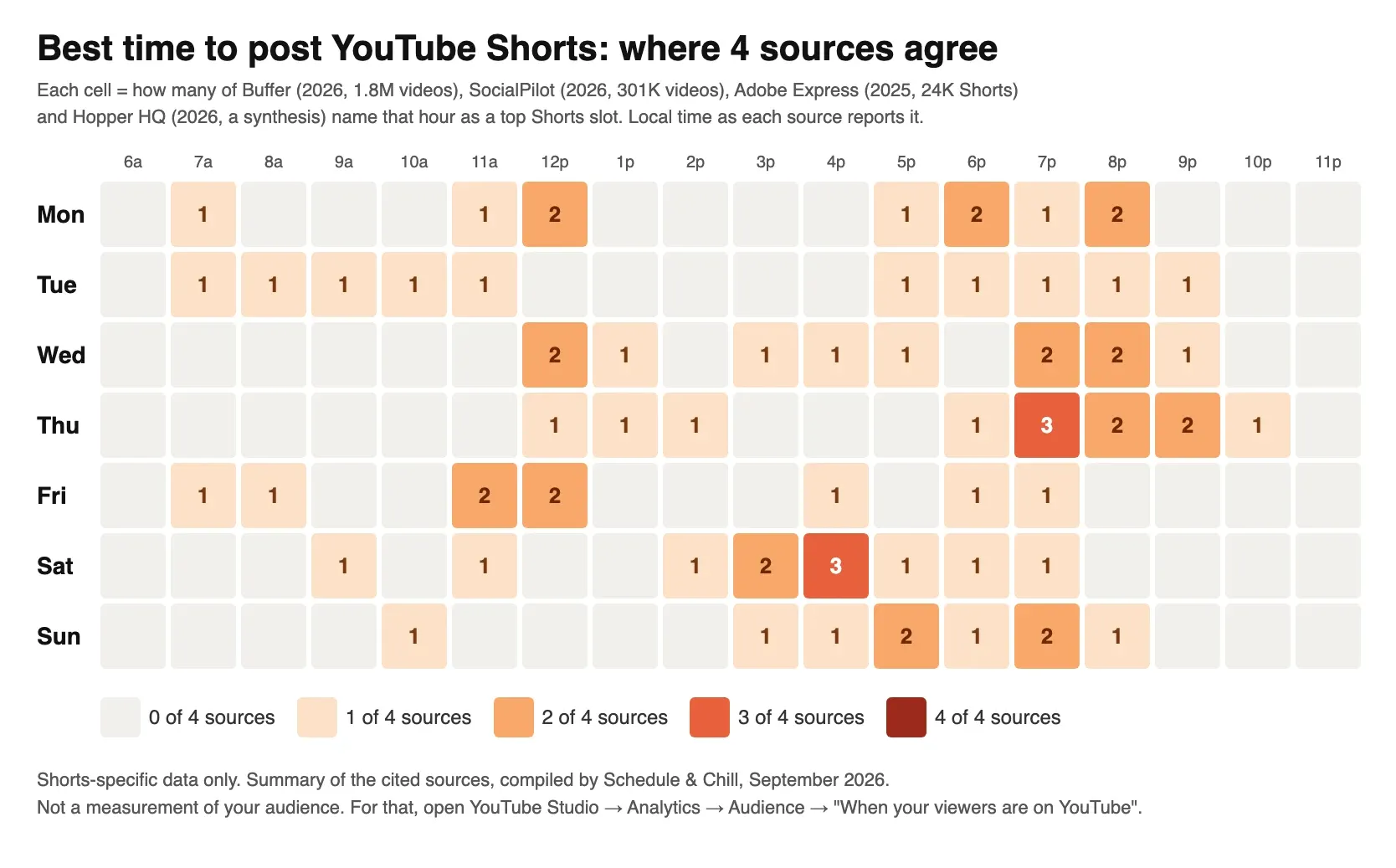
What the chart shows:
- No hour is named by all four sources.
- Three of four agree on only two slots: Thursday 7 p.m. and Saturday 4 p.m.
- Two of four agree on a scattered set: weekday evenings around 7–8 p.m. (Monday, Wednesday, Thursday), weekday lunch around 12 p.m. (Monday, Wednesday, Friday), and Sunday early evening.
- Mornings before 11 a.m. are thin. Only SocialPilot names them.
This chart is a summary of the cited sources. It is not a measurement of any audience, including yours.
#What YouTube itself says about timing
YouTube has not published a best time to post Shorts. Here is what it has said, in its own words.
The Shorts product lead says time of day is not a lever. In a 2023 Creator Insider video, YouTube Shorts Algorithm — Explained!, Shorts product lead Todd Sherman answered creator questions. TechCrunch summarised his answer: time of day "is also not a factor to optimize for, with the exception of someone focused on news." MediaPost reported the same point: creators should not worry about when they post as much as what they post.
Shorts find their audience in stages. In the same video, Sherman explained why a Short can take off and then slow down. The system tries to "find like a seed audience," and "depending on how that goes, it may get a lot more traffic or it may taper off." How that seed audience reacts matters more than the minute you pressed publish.
Recency does count in the Shorts feed. YouTube's help page Good to know about recommendations says: "The Shorts feed, with its snackable and trendy nature, may tune up on the recency of content." The same page says the system "learns from signals like time of day and device type" to match each viewer's routine. So a Short gets its best chance while it is new. That is an argument for posting often and steadily, not for one magic hour.
YouTube points you to your own data. The Audience tab has a report called When your viewers are on YouTube. YouTube's help page Understand your YouTube audience says it "shows you when your viewers are online across YouTube in the last 28 days." YouTube's tips page says the audience reports can help you "determine what time and day is best for you to upload videos."
#Why timing matters less for Shorts than for long-form
This is not a guess. Four separate sources point the same way.
| Evidence | Source | What it says |
|---|---|---|
| Time of day is not a lever | YouTube Shorts product lead, Creator Insider (2023) | Not a factor to optimize for, except for news |
| Shorts keep getting shown | Buffer (2026) | Shorts are "continuously resurfaced by YouTube's recommendation engine over days or even weeks, which means the initial publish time is less make-or-break" |
| Shorts can find viewers later | SocialPilot (2026) | "A Short posted at a suboptimal time can still find its audience" |
| Hour gaps fade even for long-form | vidIQ (2026) | Across 40.2 million long-form uploads, the gap between best and worst hours "had shrunk to within a few percent by day 30" |
| The busiest slot was not the best | Adobe Express (2025) | Shorts posted outside the busy 8–10 a.m. upload window averaged 8.7 million views, against 6.2 million inside it |
There is also a structural reason. SocialPilot describes a new video's first test audience as "a small segment of your subscribers and recent viewers." For long-form, that is where the early push comes from. Shorts, by contrast, are mostly watched in the swipe feed. Creator Jenny Hoyos said on the YouTube blog that for her, "99.9% of the views are coming from the Shorts feed." If most viewers find you in the feed, the hour your subscribers are awake matters less.
Timing still helps a little. A Short that lands while your viewers are awake gets its first reactions sooner. Just do not expect the hour to rescue a weak hook. TikTok works differently here: its For You feed tests a video fast, as our data on Shorts and TikTok view lifespans shows.
#How to read "When your viewers are on YouTube"
This takes about ten minutes and costs nothing.
- Open Analytics. On a computer: go to studio.youtube.com, then Analytics in the left menu. On a phone: open the YouTube Studio app and tap Analytics.
- Open the Audience tab. It is in the top menu of Analytics.
- Scroll to "When your viewers are on YouTube". It is a heatmap of days and hours. Darker purple means more of your viewers were online. It covers the last 28 days.
- Check the timezone. Buffer's walkthrough says the chart is set in your local time. If your viewers live somewhere else, convert before you plan.
- Check "Top geographies" on the same tab. If most watch time comes from one country, plan in that country's time.
- Check "Formats your viewers watch on YouTube." If your viewers mostly watch long videos, the chart describes long-form viewers. Shorts viewers from the feed may behave differently.
- Write down the 2–3 darkest blocks for each day. Do this twice, two weeks apart. One period can be unusual.
- Pick a slot an hour or two before the darkest block. Buffer and vidIQ both suggest posting before the peak. vidIQ's reason: Shorts are scored on whether viewers "watch or swipe away in the first one to three seconds," so posting early gives YouTube time to test the Short before the crowd arrives.
A note for new channels: YouTube's help page says some Analytics data "may be limited." If your chart is empty or thin, use the default from the studies above and run the test below.
#A simple 2-week test plan
Pick two candidate slots: one from your audience chart and one from the study consensus, for example 12 p.m. and 7 p.m. Post the same kind of Short at each. Keep length, format and hook style the same.
| Day | Week 1 | Week 2 |
|---|---|---|
| Monday | Slot A (12 p.m.) | Slot B (7 p.m.) |
| Tuesday | Slot B (7 p.m.) | Slot A (12 p.m.) |
| Wednesday | Slot A | Slot B |
| Thursday | Slot B | Slot A |
| Friday | Slot A | Slot B |
| Saturday | Weekend slot (4 p.m. or from your chart) | Weekend slot |
| Sunday | Rest | Rest |
Rules for a fair test:
- Swap the slots between weeks. Then each slot gets each weekday once, and you are testing the hour, not the day.
- Record at 48 hours and again at 7 days. Shorts keep collecting views for days, so a next-morning number is too early.
- Log more than views. In YouTube Studio, open the Short's analytics and note views, viewed vs. swiped away, average percentage viewed and subscribers gained. YouTube added the "viewed vs. swiped away" metric so creators can see how often a Short is watched instead of skipped (Search Engine Journal covers it).
- Compare the median, not the best Short. One viral Short tells you about that Short, not the hour.
- Expect a small gap. As a rule of thumb, if the two slots finish within about 20% of each other, timing is not your bottleneck. Spend the effort on the first second instead.
Here is a log you can copy into a spreadsheet:
 1date,day,slot,posted_at_local,views_48h,views_7d,viewed_vs_swiped_pct,avg_pct_viewed,subs_gained,notes
 22026-09-28,Mon,A,12:00,,,,,,
 32026-09-29,Tue,B,19:00,,,,,,
After two weeks, keep the winning slot for a month. Then test it against one new candidate. Audiences shift with school terms and seasons, so repeat the test every few months.
#Timezone advice
Most "best time" mistakes are timezone mistakes.
- Post in your audience's timezone, not yours. If you live in Dhaka and most viewers are in the US, 7 p.m. for you is 9 a.m. in New York.
- Know which clock each study used. Buffer adjusted its times so they apply in your local time. SocialPilot reports your audience's local time. vidIQ uses Eastern. Adobe does not say. Do not add or subtract hours from a number that is already local.
- Split audience? Pick the overlap. For a US and UK audience, early afternoon in New York is early evening in London. SocialPilot's article lists separate best times for 10 countries.
- Daylight saving time moves your slot. The US and Europe change clocks on different weekends, so the gap between them can be 4 or 5 hours depending on the week.
- Shorts and long-form need separate clocks. If you post both, Buffer's data suggests mornings for long-form and evenings for Shorts. A weekly TikTok posting calendar needs its own clock too, if the same clips go there.
#Why consistency beats the perfect hour
A Short that is never posted gets zero views at any hour. Since the Shorts feed leans toward recent videos, a steady flow of new Shorts gives YouTube more chances to find your seed audience.
The best slots are also often awkward. Thursday 7 p.m. is dinner time. Saturday 4 p.m. is when you are out. This is why scheduling helps: you make Shorts when you have time, and they go out when your viewers are online.
For the full how-to, read how to schedule YouTube Shorts. For a weekly plan, use the YouTube upload calendar. To compare tools, see our YouTube video scheduler guide.
#Schedule & Chill
Schedule & Chill is a free scheduler that posts to YouTube, LinkedIn, Bluesky and Mastodon. You set your posting slots once, in your profile's timezone, and each new post drops into the next free slot. So once your test finds your best hours, you set them one time and stop thinking about them. You can also schedule from Claude or ChatGPT through our MCP server. The free plan includes 2 social accounts, 500 posts a month and uploads up to 400 MB.
If you post the same clip on TikTok, the timing is different there: see the best time to post on TikTok and our YouTube Shorts vs TikTok comparison. For LinkedIn, read the best time to post on LinkedIn.
#Keep reading
- How to set a publish time on a Short — the scheduler, its time zone field and the Pacific Time date quirk.
- Best time to post on TikTok, 4 studies compared — the same side-by-side method for TikTok's feed.
- Uploading a week of Shorts from a PC — batch up to 15 files and schedule each one.
- Shorts safe zone and export settings — a Short posted at the right hour still needs text the buttons don't cover.
- LinkedIn posting frequency, 7 sources compared — the frequency data, if LinkedIn gets the same clip.
#Frequently Asked Questions
What is the best time to post YouTube Shorts? Check your own chart first: YouTube Studio → Analytics → Audience → When your viewers are on YouTube. With no data, the studies overlap most on weekday evenings, 6–9 p.m., and on Thursday 7 p.m. and Saturday 4 p.m., in your audience's local time.
What time do YouTube Shorts go viral? No time makes a Short go viral. YouTube's Shorts product lead said time of day is not a factor to optimize for, except for news. The system first tests a Short on a seed audience, and how those viewers react decides whether it spreads. A strong first second matters far more than the hour.
What is the best day to post YouTube Shorts? The studies disagree. Buffer, SocialPilot and vidIQ say Friday. Adobe Express says Tuesday and rates Friday among the weakest days. Test a weekday and a weekend slot on your own channel before you pick one.
Should I post YouTube Shorts in the morning or evening? Most Shorts data points to the evening. Buffer found Shorts engagement peaks between 6 and 11 p.m., while long-form videos do best in the morning. SocialPilot also names a lunchtime window, 12–2 p.m.
Does posting time matter for YouTube Shorts? A little, but less than for long-form. Shorts are mostly watched in the swipe feed, and Buffer found they keep getting resurfaced for days or weeks. Recency still helps in the Shorts feed, so posting steadily matters more than hitting one exact hour.
How often should I post YouTube Shorts? As often as you can keep up with for months. YouTube's Shorts product lead said there is no magic number of posts, and quality beats quantity. A few good Shorts a week on a steady schedule is a sensible start. Our YouTube upload calendar has a ready weekly plan.