

How Often to Post on LinkedIn: 7 Sources Compared
For most people, the answer to how often to post on LinkedIn is 2 to 4 times a week, every week, with no more than one post a day. Post more only if the quality holds and you can keep the pace for months, not weeks.
That range is where the largest recent studies overlap. But they do not agree on what happens above it. Buffer's data says every extra post makes each post stronger. MagicPost's data says each post gets a little weaker, while the week as a whole gets stronger. This guide puts the numbers side by side, separates personal profiles from company Pages, and gives you a 4-week test to find your own pace. Posting pace is one part of a bigger personal branding plan for LinkedIn; this guide covers only the frequency question.
#Quick answer
- Good default: 2–4 posts a week on a personal profile. Buffer, Richard van der Blom and MagicPost all land near this range.
- Starting out: 2 posts a week, plus 10–15 minutes of commenting a day.
- Maximum per day: 1 post. If you post twice, leave at least 7 hours between them.
- Company Page: at least weekly. LinkedIn says Pages that post weekly see 2x more engagement. Hootsuite advises 1–2 a day for brands with the content to support it.
- Can you post too much? Per post, maybe. Per week, the studies found no cliff. The risk is quality and burnout, not a hidden penalty.
- How to decide: run a 4-week test and compare impressions per week and followers gained, not your single best post.
#How often to post on LinkedIn: what 7 sources say
I read each of these in full on 24 September 2026. Where a source is a summary of someone else's research, the table says so.
| Source | Year | Sample | What it covers | Recommendation | Key number |
|---|---|---|---|---|---|
| Buffer | 2025 (Aug) | 2M+ posts, 94,000+ accounts | LinkedIn accounts, each compared with its own average | 2–5 posts a week | vs 1 post a week: +1,182 impressions per post at 2–5, +5,001 at 6–10, +16,946 at 11+ |
| MagicPost | 2026 (Jun data) | 26,428 creators, 12 months | Personal profiles, by follower range | Start at 1–2 a week, step up when easy | 1k–10k followers: median likes per post fall from 29 to 8 as pace rises; likes per week rise from 11 to 114 |
| Richard van der Blom, on Creator Science #307 | 2026 (Jun) | 1.3M posts, 50,000 creators | Creators | 2–4 posts a week | "Optimal posting frequency: down from 5-6x to 2-4x per week"; reach down 60% for active creators over two years |
| Melanie Goodman's roundup | 2026 (May) | Not stated (summary of reports she studied, incl. van der Blom) | Creators | 2–4 posts a week | Daily posting: "a 26% drop in average reach per post" |
| Hootsuite | 2025 (Apr) | Not stated (expert advice plus Q1 2025 posting data) | Businesses | 1–2 posts a day | Businesses actually posted 5.5 times a week on LinkedIn in Q1 2025 |
| Sprout Social | 2025 (Aug) | ~3B messages, 1M public profiles (LinkedIn company Pages) | Brands | No more than 1 a day | "Industry average: 1 post per day"; quotes 2–5 a week as expert consensus |
| LinkedIn: Pages best practices and #AskLMS | Undated; 2014 | Not stated | Company Pages | At least weekly; in 2014, "1 update per day at a minimum" | "Companies that post weekly see a 2x lift in engagement" |
Three things stand out.
Almost everyone lands between 2 and 5 posts a week for people. Buffer, van der Blom, Goodman and Sprout's quoted experts all name a range inside that band. It is the safest starting point.
The advice for brands is higher. Hootsuite says 1–2 a day, LinkedIn's 2014 answer said at least daily, and real businesses post about 5.5 times a week. A company Page with a team behind it is a different job from a founder writing their own posts.
LinkedIn has no official number for members. LinkedIn's own frequency advice is for Pages. Its Help Center does not tell members how often to post. Any "LinkedIn recommends X posts a week for you" claim is someone else's number.
#Does posting more lower your reach per post?
This is where the data splits, and it is worth understanding why.
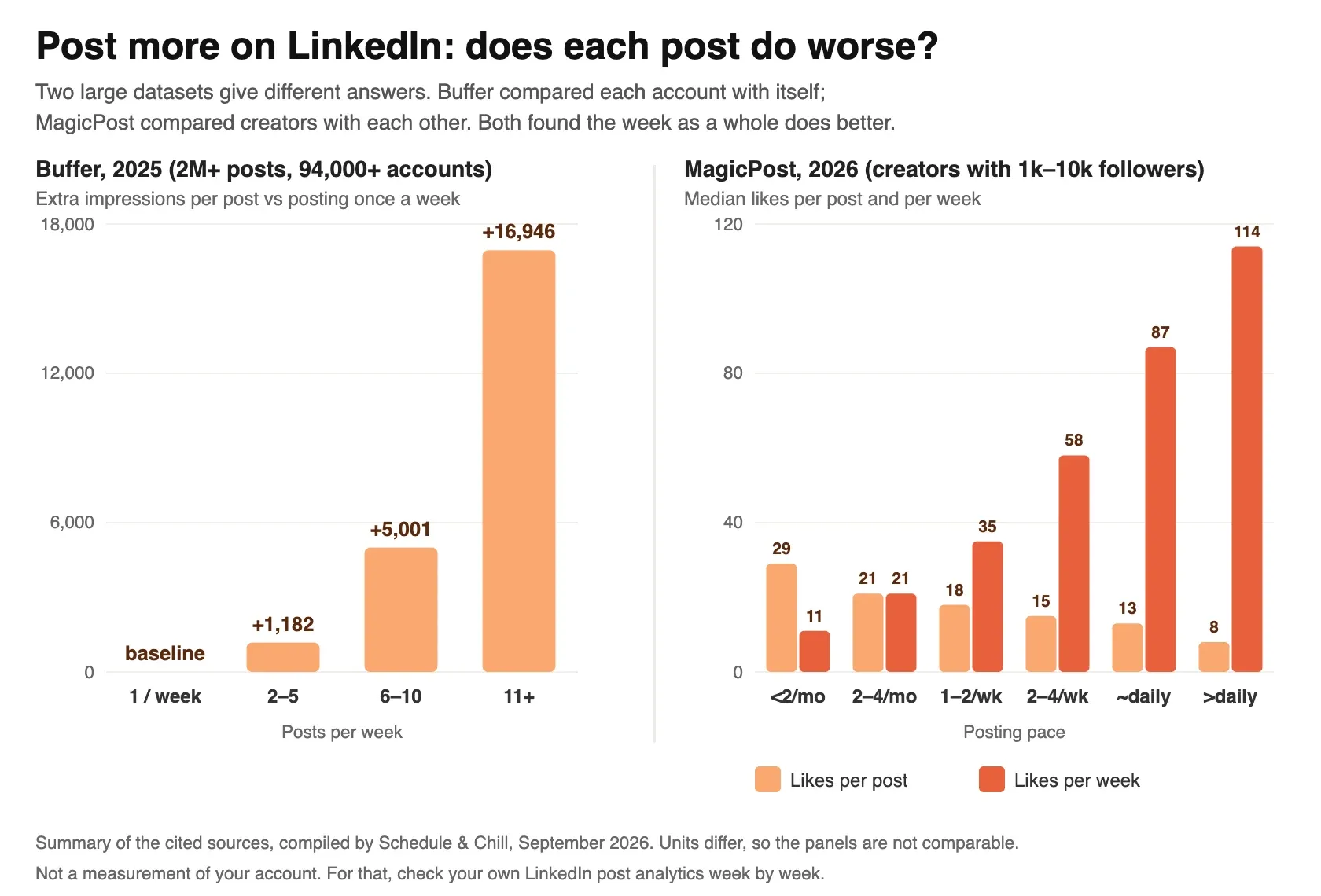
This chart is a summary of the cited sources. It is not a measurement of any account, including yours.
- Buffer compared each account with itself. It looked at the same account's busy weeks against its quiet weeks, and controlled for account size. In those busy weeks, each post got more impressions, not fewer. Buffer's conclusion: "LinkedIn doesn't 'cap' your reach or punish you for posting often."
- MagicPost compared creators with each other. People who post daily get fewer likes per post than people who post twice a month. But they get far more likes per week. MagicPost says itself that this is "correlation, not a controlled experiment."
- Goodman's roundup reports a 26% drop in reach per post for daily posting. It does not publish the sample or method behind that figure, so treat it as a warning sign, not a measurement.
Two more facts help here. Van der Blom's 2025 report found the feed now shows "fewer posts from the same creators" (his summary on LinkedIn). And posts that start conversations can stay in the feed for 2–3 weeks (AuthoredUp). Both point the same way: a good post does not need a new post on top of it the next morning.
The practical reading: more posts almost always mean more total reach per week. Whether each post gets weaker depends on whether your extra posts are as good as your usual ones. Buffer's data scientist says the same thing: "Low-quality content posted frequently won't yield great results."
#Personal profile vs company Page
The two have different jobs and different numbers. Do not copy a brand's schedule onto your profile.
| Personal profile | Company Page | |
|---|---|---|
| Typical advice | 2–4 posts a week | Weekly minimum, 3–5 a week if you have the content |
| Most-cited source | Buffer 2025, van der Blom 2026 | LinkedIn Pages best practices, Hootsuite 2025 |
| What real accounts do | 1–2 a week is the most common pace at 1k–10k followers (MagicPost) | 5.5 a week on average (Hootsuite, Q1 2025) |
| Reach | Higher. People follow people. | Lower. Van der Blom's 2024 research put organic Page posts at about 2% of the feed (AuthoredUp summary) |
| Who writes | You | A team, often with approvals |
| Best extra lever | Commenting on other people's posts | Employees resharing, and paid boosts |
If you run both, put most of your effort into the profile, then reshare or adapt the best posts on the Page. The LinkedIn personal branding guide explains why a profile usually beats a Page for founders and consultants.
#How far apart should LinkedIn posts be?
Spacing matters more than the weekly total when you post often.
| Situation | Minimum gap | Source |
|---|---|---|
| Default | About 24 hours (one post a day) | AuthoredUp's algorithm guide: "Avoid posting more than once in 24 hours" |
| Two posts in one day | At least 7 hours | Neil Patel's 2024 analysis of 332,490 accounts; AuthoredUp says the same |
| Three or more a day | Don't | AuthoredUp says none of the successful profiles it analysed post 3+ times a day |
| Two posts, same day | Use different formats | Hootsuite quotes Trish Rishwick: "I would avoid posting two PDFs [in one day]" |
The reason for the gap is simple. A new post can take attention away from the one before it while that one is still being tested with your network. Neil Patel puts it plainly: "If you post them too close to each other, it affects the previous post's reach." If you do post twice in a day, pair a text post with an image or a LinkedIn PDF carousel, not two documents.
A simple rule: one post per weekday at most, same time slot, and let a strong post run. If a post is still collecting comments the next morning, move the next one back a day. For the timing itself, read the best time to post on LinkedIn. The short version: your audience's timezone matters more than the hour.
#How often to post by goal and stage
Pick the row that matches you now, not the one you hope to reach.
| Stage or goal | Posts per week | Comments per day | Time per week | Why |
|---|---|---|---|---|
| Starting out (under 1,000 followers) | 2 | 5–10 | 2–3 hours | Build the habit first. Comments bring more readers than your own posts at this size. |
| Growing (1k–10k followers) | 3 | 10 | 3–4 hours | Buffer's first big lift is at 2–5 a week. Three is sustainable. |
| Established (10k+ followers) | 3–5 | 10+ | 4–6 hours | You have enough feedback to know which topics work. Add formats, not filler. |
| Founder selling B2B | 2–3 | 10 | 2–4 hours | You need trust with a small group of buyers, not volume. Read founder-led LinkedIn. |
| Job seeker | 1–2 | 5 | 1–2 hours | Steady, relevant activity beats volume. Comments show expertise cheaply. |
| Company Page | 3–5 | Reply to all | Team effort | Weekly is the floor LinkedIn names. Share employee posts too. |
These stages match the cadence in our 90-day LinkedIn branding plan: 2 a week in month one, 3 in months two and three, then 3–5 if quality holds.
The rule that sits above every row: pick a pace you can keep for three months. MagicPost says the same: "A rhythm you keep beats an ambition you abandon in week two." Goodman's roundup quotes research finding that creators who went quiet for weeks were "deprioritised out of existence". Stopping costs more than posting less.
#How commenting fits into your weekly effort
Posting is only half the work. Every study that looks at growth also mentions commenting.
- Buffer suggests that in a lighter week you post 2–3 times and spend 10–15 minutes a day on meaningful comments.
- Sprout Social suggests 15–30 minutes a day of thoughtful comments, plus quick replies on your own posts.
- Van der Blom describes his own 25–30 minute daily commenting system on Creator Science #307.
So a realistic week for most people looks like this:
| Task | Time |
|---|---|
| Write and schedule 3 posts in one sitting | 90–120 min |
| Comment on 10 posts a day, 5 days | 75–150 min |
| Reply to comments on your own posts | 30 min |
| Monthly analytics check (spread per week) | 10 min |
| Total | About 3.5–5 hours |
If you only have two hours a week, cut a post before you cut the commenting. A useful comment under a big post can reach more of your target readers than your own post that week. The LinkedIn post ideas list helps when the writing part is the slow part.
#How to decide from your own analytics
LinkedIn gives every member free post analytics (LinkedIn Help: Post analytics). These are the metrics that matter for a frequency decision:
| Metric (LinkedIn's name) | What it tells you about frequency |
|---|---|
| Impressions | Add them up per week. This is the number that should rise when you post more. |
| Members reached | Distinct people. If impressions rise but members reached does not, you are reaching the same people more often. |
| In network / Out of network | Share of views from followers vs new people. Out-of-network share falling as you post more is a sign of fatigue. |
| Followers gained from this post | The best single growth signal. Compare per week. |
| Profile viewers from this post | Shows whether posts make people curious about you. |
| Reactions, comments, reposts, saves, sends | Engagement. Saves and sends show usefulness. |
Two notes from LinkedIn's help page. The numbers are "estimates and may not be precise". And your own views and engagement count towards your analytics, so don't open your own post ten times and read the result as growth.
The mistake to avoid is comparing per post only. If you move from 2 to 4 posts a week, each post may get a bit less. That is fine if the week gets more. MagicPost makes the same point: "track your engagement per week, not per post, so the per-post dip does not talk you out of a step that is paying off."
#A 4-week test plan
Run this once you have at least a month of normal posting as a baseline.
| Week | Posts | Plan | What to watch |
|---|---|---|---|
| 1 | Your current pace (e.g. 2) | Baseline. Same slot each day. | Impressions per week, followers gained |
| 2 | Current pace | Second baseline week, because one week can be unusual | Same |
| 3 | Current + 1 (e.g. 3) | Add one post, same format mix, one per day max | Per-week totals vs weeks 1–2 |
| 4 | Current + 1 | Repeat, to rule out one lucky post | Same, plus out-of-network share |
Rules for a fair test:
- Keep everything else the same. Same topics, same format mix, same posting hour, same amount of commenting.
- Record numbers 7 days after each post, not the same evening. LinkedIn posts keep collecting views for days.
- Use medians, not your best post. One viral post tells you about that post, not your pace.
- Keep the higher pace if weekly impressions and followers gained rose by roughly 20% or more and the extra post did not drag on your writing time. If the gain is smaller, go back and spend the time on better posts or more comments. The 20% line is our rule of thumb, not a study result.
Copy this log into a spreadsheet:
 1week,post_date,day,posted_at_local,format,impressions_7d,members_reached,out_of_network_pct,followers_gained,profile_viewers,comments,saves,notes
 21,2026-09-29,Tue,08:30,text,,,,,,,,
 31,2026-10-01,Thu,08:30,image,,,,,,,,
 43,2026-10-13,Tue,08:30,document,,,,,,,,
To plan the posts themselves, use our LinkedIn posting calendar. It has a copy-paste monthly template.
#Schedule & Chill
The hard part of posting 3 times a week is not the writing. It is being at your desk at 8:30 on a Tuesday. Schedule & Chill solves that part. You set your weekly posting slots once, in your timezone, and each new post drops into the next open slot. A slot that already has a post is skipped, so two posts never land on the same minute.
It is free right now: 2 social accounts, 500 posts a month and 400 MB uploads. It also posts to Bluesky, Mastodon and YouTube, and you can schedule from Claude or ChatGPT through our MCP server (free LinkedIn scheduling for AI tools). Honest limits: it posts to personal LinkedIn profiles, not company Pages, it can't tag people or companies, and first comments are paused until LinkedIn approves the API access they need. The commenting part of your week is still yours to do by hand.
If you also post short video, the same test-your-own-data method works there: see the best time to post on TikTok and the best time to post YouTube Shorts.
#Keep reading
- LinkedIn personal branding: the full 90-day system — where posting pace fits with profile, comments and analytics.
- LinkedIn headline examples, grouped by role — more posts bring more profile visits, so make the headline worth it.
- Hiring a LinkedIn ghostwriter to keep the pace — when writing time is what limits your frequency.
- A free LinkedIn content calendar with CSV — turn the pace you pick into dated posts.
- Hooks that fit before LinkedIn's "See more" — more posts only help if each one earns the click.
#Frequently Asked Questions
How often should you post on LinkedIn? Two to four times a week on a personal profile, with no more than one post a day. Buffer (2025, 2M+ posts), Richard van der Blom (2026, 1.3M posts) and MagicPost (2026, 26,428 creators) all land near that range. Start at 2 a week and add one post at a time while quality holds.
Is posting twice a day on LinkedIn too much? For most people, yes. If you do it, leave at least 7 hours between posts and use different formats, because a second post too soon can take reach from the first. AuthoredUp says none of the successful profiles it analysed post three or more times a day.
Is posting every day on LinkedIn too much? Not if you can keep the quality. Buffer found each post did better in weeks when the same account posted more, and MagicPost found the weekly total kept rising up to daily. Goodman's 2026 roundup reports daily posting cut reach per post by 26%. Test it for two weeks and compare weekly totals.
How often should a LinkedIn company Page post? At least once a week. LinkedIn's Pages best-practices page says companies that post weekly see a 2x lift in engagement. Hootsuite recommends 1–2 posts a day for brands, and businesses averaged 5.5 posts a week in Q1 2025. Three to five a week is a realistic middle.
What is the 4-1-1 rule on LinkedIn? It is a content-mix rule of thumb, not a LinkedIn rule: for every six posts, share four pieces of useful content from others, one soft promotion and one direct promotion. It is about what you post, not how often. For most individuals, a mix of lessons, stories and opinions works better. See LinkedIn post ideas.
What is the golden hour for LinkedIn posts? The first 30–60 minutes after you post. AuthoredUp, citing van der Blom's 2025 research, says early likes, comments and shares in that window shape how far a post travels. Post when you can stay around to reply, which is one more reason to keep a fixed slot.