

LinkedIn Ghostwriter: Costs, Vetting and Workflow
A LinkedIn ghostwriter interviews you, turns your ideas and stories into posts in your voice, and sends them to you for approval before they go out under your name. Published prices in 2026 run from about $700 a month for a small agency package to $2,000–$3,000 a month for an experienced writer, and five figures for premium executive agencies.
This guide is for founders and B2B professionals deciding whether to hire one. It covers what the job includes, what it costs (with every number linked to where it came from), how to vet a writer, how to give them access without sharing your password, and when doing it yourself is the better choice. Sources were checked on 24 September 2026.
#Quick answer
- What does a LinkedIn ghostwriter do? Interview, draft, get your approval, schedule, and help you with engagement. Writing is only part of it. Getting the ideas out of your head is most of the work.
- What does it cost? Published packages we found: $697/month for 12 posts, $2,000/month and up for about 15 pieces, $2,900/month for 16 posts plus engagement. See the price table below.
- Is it honest? Most people accept it when the ideas are yours and you approve every post. A survey of 291 PR professionals found the same condition (Gallicano et al., 2013).
- Should they have your password? No. LinkedIn's User Agreement bans sharing log-in details (section 8.2). Use drafts and a scheduler on your side.
- Who should not hire one? Anyone who doesn't know their position yet. A ghostwriter can't invent your point of view.
#What a LinkedIn ghostwriter actually does
The job is closer to an interviewer and editor than a writer. Most of the value comes from pulling real stories and opinions out of you, then shaping them so they read well on LinkedIn.
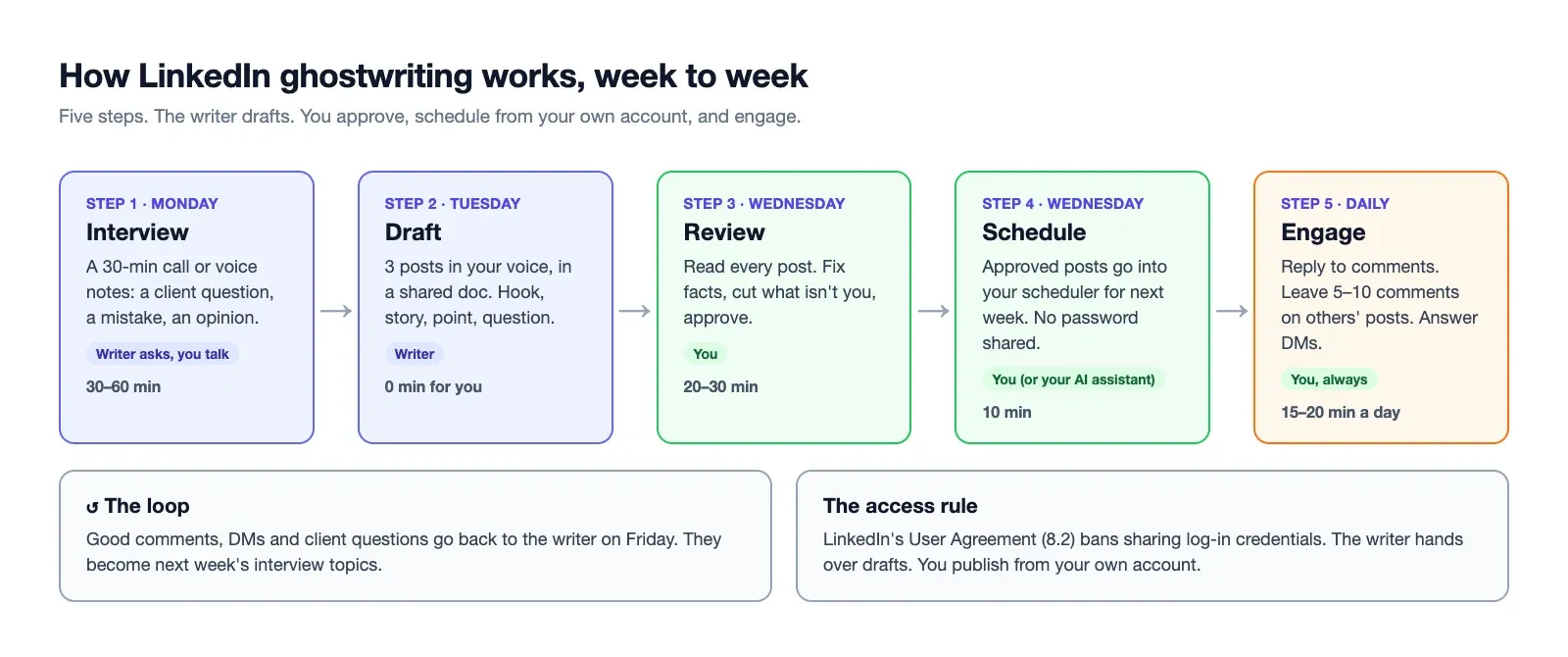
| Step | What happens | Who does it | Your time |
|---|---|---|---|
| 1. Interview | A 30–60 minute call, or voice notes. The writer asks about wins, mistakes, client questions and opinions. | Writer leads, you talk | 30–60 min a week |
| 2. Draft | The writer turns the notes into posts: hook, story, point, question. | Writer | None |
| 3. Review | You read every post, fix facts, cut what isn't you, approve. | You | 20–30 min a week |
| 4. Schedule | Approved posts go into a scheduler for the week. | You, or the writer through a draft handoff | 10 min |
| 5. Engage | Replying to comments, commenting on others' posts, DMs. | You | 15–20 min a day |
Two things to notice. First, the founder still spends about an hour a week plus daily engagement. A ghostwriter cuts your writing time, not your presence. Second, the engagement step should stay with you. LinkedIn's rules ban "bots or other unauthorized automated methods" that "create, comment on, like, share, or re-share posts" (User Agreement, 8.2), and a comment from someone pretending to be you is exactly the part readers feel is fake.
For the full system a ghostwriter plugs into (position, profile, pillars, engagement, measurement), see our LinkedIn personal branding guide.
#How much does a LinkedIn ghostwriter cost?
There is no official price survey for LinkedIn ghostwriting. What exists is agency price pages, marketplace rate pages, and agency blogs that estimate the market. The table shows each number with its source and what kind of source it is. Treat agency blog estimates with care: they sell the service they are pricing.
| Source (checked 24 Sep 2026) | Type | Price | What it includes |
|---|---|---|---|
| Cleverly | Agency price page | $697/month | 12 posts a month, content interviews, calendar, profile work |
| Column (Mar 2024) | Agency price page | From $2,000/month | About 15 pieces a month, writing, design and research |
| Pete Codes | Solo writer price page | $2,900/month or $8,000 for 3 months | 16 posts, 40 replies and 100 follows in your niche a month |
| Fiverr guide (Nov 2024) | Marketplace guide, all ghostwriting | $49–$84/hour or $0.10–$0.70/word | Mostly book work, not LinkedIn |
| Mylance (May 2026) | Agency blog estimate | $500–$1,500 (budget), $2,000–$5,000 (mid), $5,000–$15,000+ (premium) a month | Budget = 4–8 posts, mid = 12–16 posts |
| Windmill Growth (2026) | Agency report, own clients | $1,500–$3,000/month average spend | Based on its own 185+ clients |
The Fiverr numbers cover all ghostwriting, not LinkedIn only. Treat them as a floor, not as the price of a specialist.
#What the price usually buys
| Price band (monthly) | Typical posts | What's usually missing |
|---|---|---|
| Under $1,000 | 8–12 | Deep interviews. Expect more generic topics. |
| $1,000–$3,000 | 12–16 | Strategy beyond content. Usually fine for founders. |
| $3,000–$5,000 | 12–20 | Rarely anything. Often adds engagement help and reporting. |
| $5,000+ | Varies | Nothing, but you are paying for positioning and a senior team. |
A simple way to judge any quote: divide the monthly price by the number of posts. At $2,000 for 12 posts you pay about $167 a post. Then ask whether one good post a week brings you one conversation a month worth more than that. For most founders selling B2B, one real sales call is.
#Engagement models: per post, retainer or agency
| Model | How it's priced | Good for | Watch out for |
|---|---|---|---|
| Per post | Flat fee per post, often $50–$500 | Testing a writer, occasional posts | No interviews, so posts drift from your voice |
| Monthly retainer (freelancer) | Fixed fee for a set number of posts | Founders who want 2–4 posts a week | One person. Holidays and sick days stop your posts. |
| Agency | Monthly package, often with a minimum term | Executives who want strategy, design and reporting | Your writer may change. Ask who writes. |
| Hourly | Hourly rate for interviews and editing | Founders who write their own first drafts | Hard to budget |
Start with a paid trial of 2–4 weeks before any 3-month commitment. A writer who is good will not mind.
#How to vet a LinkedIn ghostwriter
Ask to see live posts they wrote for real clients, with the client's permission. Then run a short interview with these questions:
- "Walk me through how you capture a client's voice in the first two weeks."
- "What do you need from me each week, in minutes?"
- "How do posts get from your draft to my profile?" (The right answer does not include your password.)
- "Do you use AI tools? Where, and where not?"
- "What happens if I reject most of a week's drafts?"
- "Who owns the drafts and the ideas list if we stop working together?"
- "What will you report to me each month?"
#Red flags
- Asks for your LinkedIn password or wants to "log in as you"
- Promises follower numbers or "going viral"
- Offers to automate comments, likes or connection requests on your account
- Can't show work for clients in your field, or anything recent
- Sends a first draft without asking you a single question
#A vetting scorecard
Score each writer 1–5 on each line. Anyone under 25 out of 35 is a no.
| Criterion | What a 5 looks like | Score |
|---|---|---|
| Relevant samples | Live posts for 2+ clients in or near your field | /5 |
| Interview process | A clear weekly interview or voice-note routine | /5 |
| Voice match (trial post) | You'd post it with only small edits | /5 |
| Safe access | Drafts handed over for you to schedule, no password | /5 |
| Honest about results | Talks about conversations and leads, not virality | /5 |
| Clear terms | Price, posts, revisions, notice period in writing | /5 |
| Reporting | Monthly look at impressions, profile views, conversations | /5 |
#A sample weekly workflow between founder and ghostwriter
| Day | Founder | Ghostwriter | Time for founder |
|---|---|---|---|
| Monday | 30-minute call, or 3 voice notes on your phone | Asks about the week: a client question, a mistake, an opinion | 30 min |
| Tuesday | Nothing | Drafts 3 posts from the call | 0 |
| Wednesday | Reads drafts, edits facts and tone, approves | Makes changes | 20–30 min |
| Wednesday | Schedules the 3 posts for next week | Suggests times | 10 min |
| Daily | Replies to comments, leaves 5–10 comments on other posts | Flags good comments to reply to, collects ideas | 15–20 min |
| Friday | Forwards good DMs and client questions | Adds them to the ideas list | 5 min |
Three posts a week is a good target for most founders. Our guide on how often to post on LinkedIn covers the trade-offs, and the LinkedIn posting calendar gives you a month-long template both of you can work from. Ask the writer to suggest times from your own analytics, as explained in when to post on LinkedIn for your audience.
#Is LinkedIn ghostwriting ethical?
It depends on whose ideas they are. The most useful research here is older and about blogs, not LinkedIn, but the logic carries over.
In a 2011 survey of 291 PRSA members, published in the Public Relations Journal in 2013, most respondents accepted undisclosed ghost blogging "provided that the content comes from the executive and the executive provides content approval." A substantial minority still disagreed (Gallicano, Brett and Hopp, via the Institute for Public Relations). The authors compare it to speechwriting, and note the comparison breaks if the executive does not approve each post.
LinkedIn's own rules put the responsibility on you. The User Agreement says "you are responsible for anything that happens through your account" and asks you to review AI-generated content before you share it (User Agreement, 2.2 and 3.6).
A practical line to hold:
| Acceptable | Not acceptable |
|---|---|
| Your ideas, stories and opinions, written up by someone else | Opinions you don't hold, invented stories |
| You approve every post before it goes out | Posts published without you reading them |
| You write your own comments and DMs | Someone else replying to people as you |
| Numbers and claims you can back up | Made-up results or client wins |
If someone asks you directly whether you use a writer, say yes. Nobody thinks less of a founder with an editor. They do think less of one caught pretending.
#How ghostwriter access should work (without your password)
LinkedIn is clear on this. Section 8.2 of the User Agreement says you must not "use or attempt to use another's account (such as sharing log-in credentials or copying cookies)", and section 2.2 says you will "not share or transfer your account or any part of it" (LinkedIn User Agreement, effective 3 November 2025). LinkedIn Help adds that it needs "direct contact from account owners" for any account change (LinkedIn Help). LinkedIn Pages have admin roles you can give to others. Personal profiles don't.
A safe setup looks like this:
- The ghostwriter never logs in. They deliver drafts in a shared doc, one post per section, with image or PDF files attached.
- You own the scheduler. You connect your LinkedIn to a scheduler from your own login, paste the approved drafts, and schedule them. Ten minutes a week.
- Or you hand it to an AI assistant you control. If your scheduler has an MCP server for LinkedIn, you can ask Claude or ChatGPT to take the approved doc and schedule the posts, from your account.
- You keep the engagement. Comments and DMs come from you.
This protects you if the relationship ends, and it keeps your account within LinkedIn's rules.
#DIY vs ghostwriter vs AI-assisted: which fits you?
| Your situation | Best option | Why |
|---|---|---|
| You like writing and have 2–3 hours a week | DIY | Cheapest, and your voice is already yours |
| You have strong stories but writing takes you hours | Ghostwriter | You talk for 30 minutes, they write |
| You don't know what you stand for yet | DIY first | Nobody can outsource your position |
| Budget under $500 a month | AI-assisted | Draft with AI from your own notes, then edit hard |
| You post in a regulated field (finance, health, legal) | Ghostwriter plus compliance review | Every claim needs checking anyway |
| You want 5+ posts a week plus design | Agency | One writer rarely covers volume and design |
AI-assisted means you give an AI tool your own notes and voice memos, then rewrite the draft until it sounds like you. It is not "let the AI post for you." LinkedIn itself says AI-generated content "might be inaccurate, incomplete, delayed, misleading" and asks you to review and edit it before sharing (User Agreement, 3.6). If you're short on ideas either way, start with our list of LinkedIn post ideas.
#A copy-paste brief to send a LinkedIn ghostwriter
Fill this in before the first call. It saves the writer a week of guessing. If your profile still has a default headline, fix it first with our LinkedIn headline formula and examples, because every reader of the new posts will see it.
 1LINKEDIN GHOSTWRITING BRIEF
 2
 3About me
 4- Name, role, company:
 5- One-line position: I help [who] with [what] because [proof].
 6- LinkedIn profile URL:
 7
 8Audience
 9- Who I want to reach (job titles, company size):
10- What they worry about:
11- What I want them to do after reading (DM me, book a call, hire us):
12
13Content pillars (3-4 topics I repeat)
141.
152.
163.
17
18Voice
19- 3 posts I wrote that sound like me:
20- 3 creators I like reading, and why:
21- Words or phrases I never use:
22- Emojis, hashtags, formatting: yes / no / sparingly
23
24Rules
25- Topics that are off-limits:
26- Client names I can and can't mention:
27- Numbers I'm happy to share publicly:
28- Compliance review needed? yes / no
29
30Logistics
31- Posts per week:
32- Weekly interview slot:
33- Draft delivery day and format (shared doc):
34- I schedule posts myself. Do not ask for my password.
35- Notice period and who owns drafts if we stop:
#Scheduling ghostwritten posts with Schedule & Chill
Schedule & Chill fits the safe setup above from the founder's side. It does not have team seats or an approval flow for a writer, so the honest workflow is: your ghostwriter sends drafts, you paste the ones you approve into Schedule & Chill, and schedule them for the week. You can save a post as a draft first and schedule it later. LinkedIn's native scheduler also works, but its queue is hidden, so read where LinkedIn keeps scheduled posts before you rely on it. If you prefer, you can ask Claude or ChatGPT to schedule the approved posts for you through our MCP server, from your own account.
On LinkedIn it publishes to personal profiles: text posts, up to 9 images, one video, or one PDF document post of up to 300 pages, set to public or connections only. It is free right now: 2 social accounts, 500 posts a month and 400 MB uploads. It can't post to company Pages yet, can't add mentions (LinkedIn's API doesn't allow it), and automatic first comments are paused until LinkedIn approves the API access they need. Founders running the whole thing themselves can use the routine in founder-led LinkedIn.
#Keep reading
- The LinkedIn personal brand system a ghostwriter plugs into — position, profile, pillars, engagement and measurement.
- LinkedIn's 3,000-character limit and the "See more" fold — what to check in every draft before you approve it.
- How to make LinkedIn document carousels — if your writer also delivers PDF posts.
- A 4-week test to set your LinkedIn posting pace — how many posts a month to ask your writer for.
- Where short video goes first: YouTube Shorts or TikTok — if your writer also cuts your talks into vertical clips.
#Frequently Asked Questions
How much does a LinkedIn ghostwriter charge? Published prices we found in September 2026 run from $697 a month for 12 posts (Cleverly) to $2,900 a month for 16 posts plus engagement (Pete Codes), with Column starting at $2,000 a month. Agency estimates put premium executive work at $5,000 to $15,000 or more a month. Per-post freelance work often costs $50 to $500 a post.
How much do LinkedIn ghostwriters make? It varies with the number of clients. A writer charging $2,000 to $3,000 a month per client with three clients earns roughly $72,000 to $108,000 a year before costs. Freelance marketplace rates for general ghostwriting are lower.
Is LinkedIn ghostwriting ethical? Most people accept it when the ideas and stories are yours and you approve every post. A survey of 291 PR professionals found the same condition. It becomes dishonest when someone else invents your opinions, publishes without your review, or replies to people as you.
Should I give my ghostwriter my LinkedIn password? No. LinkedIn's User Agreement bans sharing log-in credentials and says you are responsible for everything that happens through your account. Have the writer send drafts and schedule them yourself, or use a scheduler you control.
Can AI replace a LinkedIn ghostwriter? Partly. AI can turn your notes into a first draft, which is enough for many founders on a small budget. What it can't do is interview you, push back on a weak idea, or know which story from last week is worth telling. You still need to edit every draft until it sounds like you.
How do I find a good LinkedIn ghostwriter? Look at posts from people in your field that you'd like to write, and ask them who helps. Then check live samples, run a paid 2–4 week trial, and score each writer on the scorecard above. Skip anyone who asks for your password or promises viral posts.