

Founder-Led Content on LinkedIn: A B2B SaaS Playbook
Founder-led content is when the founder of a company, not the brand account, is the main voice that teaches, tells stories and shares opinions in public. For an early B2B SaaS company it works because buyers trust a person they can check more than a logo they have never heard of, and on LinkedIn a person's posts reach far more people than a company Page's.
This guide is for B2B SaaS founders who want customers from LinkedIn and have about two to three hours a week. It covers why founder-led marketing works (with the studies), two founders who have described their results in public, what to post, how to measure it, the real risks, and a 30-day plan. Numbers are linked to their sources, checked on 24 September 2026. It is the founder-specific companion to our complete LinkedIn personal branding system.
#Quick answer
- What is it? The founder posts under their own name about the problem the product solves: lessons, numbers, customer stories and opinions. The company Page is secondary.
- Why does it work? In the 2025 Edelman-LinkedIn study, 53% of US decision-makers said that when thought leadership is high quality, how well known the company is matters much less (report PDF). That is the gap a small startup needs.
- Why the founder and not the Page? In Richard van der Blom's 2024 feed research, organic company Page posts were about 2% of what people saw (AuthoredUp summary).
- How much time? Plan on 2–3 hours a week: one writing block, plus 15 minutes of comments a day.
- How do you know it works? Ask every new trial or demo "How did you hear about us?" and count the answers that name you. Close's founder used exactly this question.
- How long until results? Give it 90 days. The first 30 are about habit, not leads.
#What founder-led content is (and what it is not)
Founder-led content is a founder sharing what they know and what they are learning, in their own voice, where their buyers already spend time. In B2B that usually means LinkedIn, sometimes also a newsletter, podcast or YouTube.
Founder-led marketing is the wider idea: the founder is the company's main marketing channel in the early years. Content is the part of it you can do every week without a budget. Sales calls, podcasts and events are the other parts.
| It is | It is not |
|---|---|
| Your opinions, with reasons | Your company's press releases, reposted |
| What you learned this month, with numbers | A highlight reel of wins only |
| Customer problems, told as stories | Product feature announcements every day |
| Written by you, or drafted from your words and approved by you | Generic posts a stranger could have written |
| A way to start conversations | A way to go viral |
#Why founder-led content works in B2B
#Buyers read it, and it shrinks the "who are you?" gap
Edelman and LinkedIn surveyed 1,934 business executives between 17 March and 3 April 2025 for their B2B Thought Leadership Impact Report (report PDF). The study counts free content from "organizations or individuals", so a founder's posts count. US figures:
| Finding (2025, US) | Share |
|---|---|
| If thought leadership is high quality, brand recognition matters less (both buyer groups) | 53% |
| Target decision-makers who spend over an hour a week on thought leadership | 64% |
| Target decision-makers who use it to vet vendors | 56% |
| Hidden decision-makers who have little or no contact with sales reps | 71% |
| Hidden decision-makers who prefer a "more human, less formal" tone | 65% |
| Target decision-makers whose C-level exec pushed a vendor after reading its thought leadership | 41% |
"Hidden decision-makers" are people in finance, legal, procurement and similar roles who can approve or block a purchase. Most of them will never take your sales call. They can read your posts. And the tone they say they prefer, human and informal, is the tone a founder writes in naturally.
The 53% line matters most for a startup. You can't beat a big competitor on brand recognition. You can beat them on how clearly you explain the buyer's problem.
#People trust people like them more than they trust "CEOs"
The 2024 Edelman Trust Barometer found that respondents trusted "someone like me" (74%) as much as scientists and experts (74%) to tell the truth about new technology. CEOs in general were trusted by only 51% (Edelman, 2024).
That is a useful warning. "CEO" is not a trusted title by default. What earns trust is sounding like a peer: someone in the same job, with the same problems, sharing what worked. Write like a founder talking to another founder, not like a CEO giving a speech.
#The feed favours people over Pages
Richard van der Blom's Algorithm Insights reports are the largest public studies of LinkedIn reach. AuthoredUp's summary of his 2024 research puts organic company Page content at about 2% of the feed, with creator content (people) at 59% (AuthoredUp). His 2025 report, based on 1.8 million posts, found organic reach fell by almost 50% year on year (van der Blom on LinkedIn).
Reach is harder for everyone, which makes the founder's profile more important, not less. It is the account with the best chance of being seen.
#Founders who built with founder-led content
Many "case studies" online are agencies describing their own clients. The two below are founders describing their own results, in their own words. Treat them as their claims, not audited numbers.
#Steli Efti, Close (sales CRM)
Steli Efti co-founded Close, launched in 2013, and started making content on day one: laptop videos about sales on YouTube, then blog posts, a podcast and conference talks (Close, "Founder-Led Content: A Secret Weapon for Startup Growth").
What he says worked:
- Topics came from customers. His two sources were the problems customers brought him and what the team was learning while building.
- Voice memos beat blank pages. Writing a blog post took him weeks. A colleague told him to record a 10-minute voice memo instead, and a writer turned it into a post within a day. Later he recorded YouTube videos right after customer calls, "an extra 10 minutes at the end of a phone call".
- Attribution was a question, not a dashboard. In the episode transcript he says that when Close asked new trial users how they heard about the company, "pretty consistently, half of them would say the content." He adds that people still name his content years after he mostly stopped making it.
- He burned out. He writes that he "eventually became burnt out" and handed content to a marketing team, which "came with its own set of problems."
Close's channel was YouTube, not LinkedIn. The lesson carries over: pick the platform where your buyers are. For most B2B SaaS founders in 2026, that is LinkedIn. If you record short videos too, the same clip can run as native LinkedIn video and on YouTube Shorts or TikTok. Our side-by-side of YouTube Shorts and TikTok helps you choose between them.
#Guillaume Moubeche, lemlist (sales outreach)
Guillaume Moubeche is the CEO of lemlist. The SaaS Marketing Superstars podcast describes him as having bootstrapped lemlist from $0 to $10M ARR in less than four years, and the episode is titled "The LinkedIn Content System that quickly scaled Lemlist to $10M ARR" (episode page).
The episode covers two things most founder-led playbooks skip: how he got his team members to post consistently on LinkedIn, and how he got over the fear of building employees' personal brands. That is one answer to the key-person risk further down this guide. The founder starts, and the team follows.
#What the two stories have in common
| Pattern | Close | lemlist |
|---|---|---|
| Started early, before they had a marketing team | Yes, from launch | Yes, bootstrapped |
| Topics came from the founder's real work | Customer calls, startup lessons | Sales and outreach |
| Found a faster way to produce | Voice memos, then video | A system, then the team |
| Spread it beyond the founder | Handed to a content team | Team members posting |
#What to post: five founder-led content types
You need three or four repeat topics, not endless new ideas. These five types cover most weeks. The example hooks are written for this guide. Swap in your own numbers.
| Type | What it shows | Example hook |
|---|---|---|
| Build-in-public numbers | You are real and honest | "Month 7: $4,100 MRR. Here's the one change that moved it, and the two that didn't." |
| Lessons and mistakes | You learn fast | "We spent 3 months on a feature 2 customers used. What I check now before building anything." |
| Customer stories | Your product solves a real problem | "A customer told me our onboarding made her feel stupid. She was right. Here's what we changed." |
| Contrarian takes | You have a point of view | "Free trials are hurting most early B2B SaaS. Here's why we switched to a demo first." |
| Behind the scenes | How you think and work | "My whole weekly schedule as a solo founder, including the 3 hours I protect for writing." |
Three rules make these work:
- One number or one specific detail per post. "Churn went down" is forgettable. "Churn went from 6.1% to 3.8% after we added a setup call" is not.
- Ask before you share customer details. Names, logos and private numbers need permission. Anonymise the rest.
- Keep selling to about one post in six. The other five earn you the right to that one.
For a longer list of prompts, see LinkedIn post ideas. For the full profile setup that should come first, see the pillar guide on LinkedIn personal branding, and fix your headline with these LinkedIn headline examples so a visitor gets what you do in five seconds.
#The founder-led flywheel
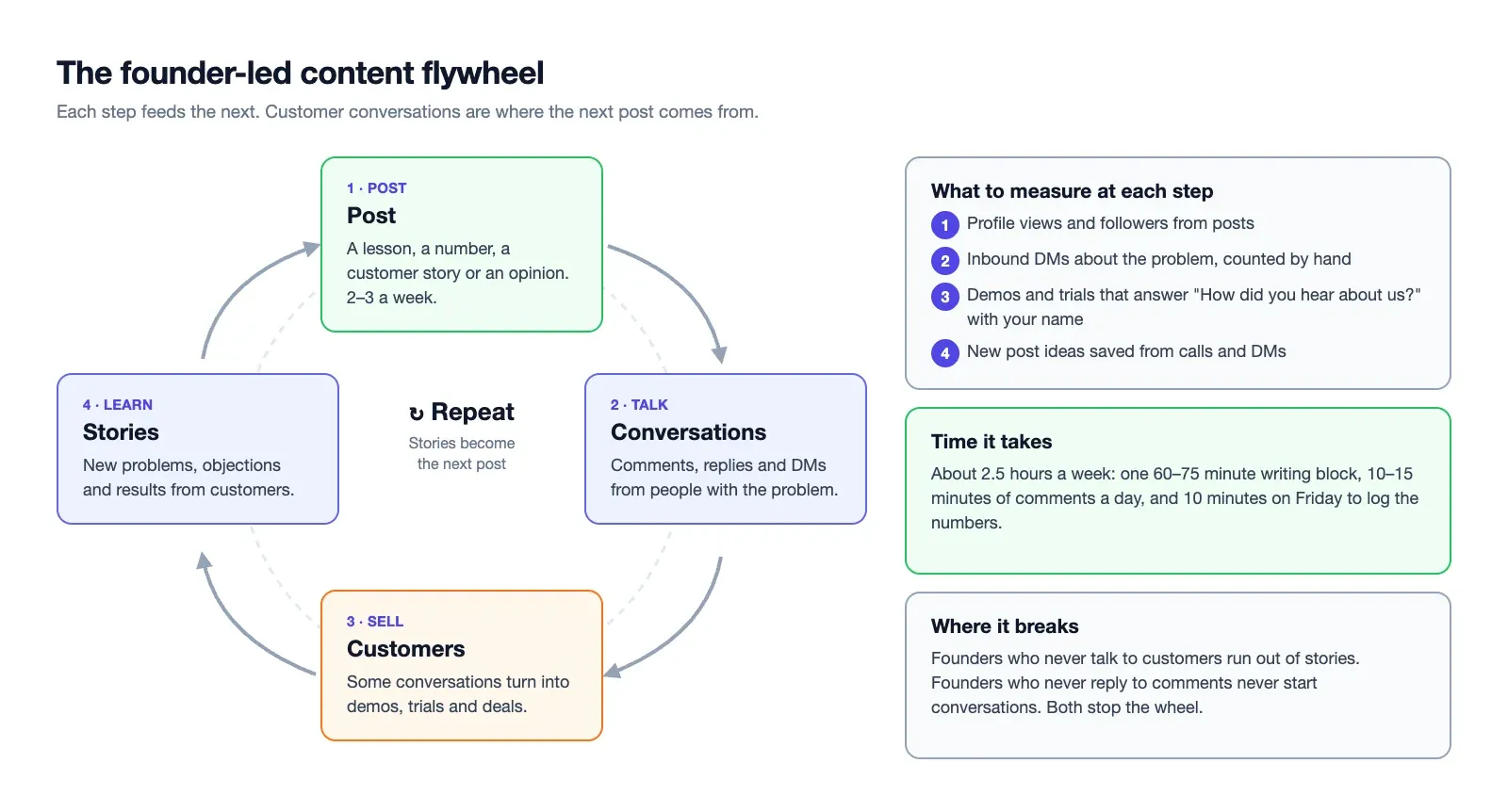
Founder-led content compounds because each step feeds the next:
- Post about a real problem your buyers have.
- Conversations start in the comments and DMs.
- Some conversations become customers, or at least demos.
- Customers give you new stories: problems, objections, results.
- Those stories become the next post.
This is why founders who talk to customers every week rarely run out of ideas, and why founders who only write from their desk usually do.
#A founder's weekly time budget
Most founders quit because it takes more time than they planned for. Budget it up front. This is about 2.5 hours a week.
| When | Task | Time |
|---|---|---|
| During the week | Save ideas from calls, DMs and support tickets to one note | 5 min a day |
| Monday | Pick 2–3 ideas, one per content type | 15 min |
| Monday or Tuesday | Write all posts in one sitting (or record voice memos) | 60–75 min |
| Right after | Schedule them for the week | 10 min |
| Each posting day | Reply to every comment in the first hour or two | 15 min |
| Daily | Leave 3–5 useful comments on posts your buyers read | 10–15 min |
| Friday | Log the week's numbers (see below) | 10 min |
Two or three posts a week is enough to start. See how often to post on LinkedIn for what the studies say about frequency, and use a LinkedIn posting calendar to plan a month at once. Schedule posts for times you can be around to reply; finding your own best LinkedIn posting time takes about ten minutes in your analytics.
#How to measure founder-led marketing
Impressions and likes are easy to count and easy to mislead you. Measure the things that sit closer to revenue. LinkedIn's free post analytics give you some of it: impressions, members reached, profile viewers, followers gained, reactions, comments, reposts and saves (LinkedIn Help). The rest you count yourself.
| Signal | Where to find it | What it tells you |
|---|---|---|
| Profile views from posts | LinkedIn post analytics | Posts make the right people curious |
| Followers gained | LinkedIn post analytics | They want more of it |
| Inbound DMs about the problem | Your LinkedIn inbox, counted by hand | Posts start real conversations |
| Demo or trial requests that mention you | "How did you hear about us?" field | Posts create pipeline |
| Deals where the buyer says they followed you | Ask on the first sales call | Posts helped close |
#The one field to add today
Add a free-text "How did you hear about us?" field to your signup or demo form. Free text, not a dropdown. People write things like "saw the founder's post about churn", which a dropdown would never capture. This is the same question Close used to find that about half of its trial users came from Steli's content.
Keep a simple log:
| Week | Posts | Profile views | Inbound DMs | Demos/trials naming you | Notes |
|---|---|---|---|---|---|
| 1 | 2 | 40 | 0 | 0 | First posts, mostly friends |
| 4 | 3 | 110 | 2 | 0 | Churn post did best |
| 8 | 3 | 180 | 4 | 1 | First demo from a post |
The numbers above are an example, not a benchmark. Compare yourself with your own past weeks. Founder-led content builds trust before it builds pipeline, so judge it by the trend over months, not by one post.
#Risks, and when to get help
Founder-led content has real costs. Know them before you start.
| Risk | What it looks like | What to do |
|---|---|---|
| Oversharing | Posting customer names, private revenue, team conflict or investor talks | Ask before naming anyone. Share trends, not every raw number. Sleep on anything emotional. |
| Time sink | Scrolling "for research", rewriting a post five times | Use the time budget above. Write in one block. Set a timer for comments. |
| Burnout | Posting feels like a second job; you dread Mondays | Drop to two posts a week. Use voice memos. Steli Efti burned out after years of it, and says so. |
| Key-person dependency | All pipeline depends on one person's profile | Get early employees posting in their own voice, as lemlist did. Keep the company Page complete. |
| Chasing reach | Writing viral-style posts your buyers don't care about | Judge posts by DMs and demos, not impressions. |
#When to hand parts to a ghostwriter
A ghostwriter or editor makes sense when you have strong opinions and real stories, but turning them into posts takes you hours. It works best like Steli's voice memos: you talk, they draft, you edit and approve every word.
Keep three things for yourself no matter what: your opinions, your replies to comments, and your DMs. Those are where the relationships start. Prices and how to brief one are in our guide to hiring a LinkedIn ghostwriter.
#A 30-day founder-led content starter plan
This plan assumes 2–3 hours a week and a profile you've already tidied up.
| Days | Focus | Actions | Done when |
|---|---|---|---|
| 1–3 | Setup | Write your one-line position. Fix headline and About. Add the "How did you hear about us?" field to your forms. | A stranger gets what you do in 5 seconds |
| 4–7 | Ideas | List 20 post ideas: 4 per content type. Build a list of 20 accounts your buyers follow. | 20 ideas and 20 accounts saved |
| 8–14 | First posts | Publish 2 posts: one lesson, one customer story. Comment 3–5 times a day. | 2 posts live, no skipped days of comments |
| 15–21 | Rhythm | Publish 3 posts, including one build-in-public number. Reply to every comment. | 3 posts, all comments answered |
| 22–28 | Point of view | Publish 2–3 posts, including one contrarian take. Send a DM to 3 people who engaged, only if there's a real reason. | First real conversations started |
| 29–30 | Review | Fill in the log. Note which type got the most DMs, not the most likes. Plan the next 4 weeks. | Next month's calendar written |
By day 30, expect around 7–8 posts, a habit, and a clearer idea of what your buyers respond to. Don't expect a flood of demos yet. Expect a few good conversations. That is the signal to keep going.
#Scheduling your founder-led content with Schedule & Chill
The weekly system above depends on writing in one block and publishing across the week. Schedule & Chill handles the publishing part. It posts to LinkedIn personal profiles: text, up to 9 images, one video, or one PDF document of up to 300 pages, set to public or connections only. You can also draft and schedule posts from an AI assistant like Claude through our MCP server (how Claude posts to LinkedIn), which suits the voice-memo workflow: talk through the idea, edit the draft, schedule it.
It is free right now: 2 social accounts, 500 posts a month and 400 MB uploads. Honest limits: it can't post to company Pages yet, it can't tag people or companies (LinkedIn's API doesn't allow it), and automatic first comments are paused until LinkedIn approves the API access they need. The comments and DMs, the part that turns posts into customers, are yours to do by hand.
#Keep reading
- LinkedIn personal branding in 90 days — the profile and positioning work that should come first.
- Turning a founder lesson into a LinkedIn PDF carousel — one of the top formats for reach in 2025 data.
- Writing a LinkedIn hook that fits before "See more" — your first line decides whether buyers read the rest.
- LinkedIn ghostwriter pricing and vetting — if the voice-memo route needs a writer on the other end.
- YouTube video scheduling for founders who film — Close grew on YouTube; this is how to queue uploads.
#Frequently Asked Questions
What is founder-led content? Founder-led content is content published by a company's founder under their own name, instead of only through the brand account. It usually covers lessons, customer stories, numbers and opinions about the problem the product solves. In B2B it mostly lives on LinkedIn, and it works because buyers trust a person they can check more than an unknown brand.
What is founder-led marketing? Founder-led marketing means the founder is the company's main marketing channel in the early years. Content is the biggest part, alongside sales conversations, podcasts and events. It is common in early B2B SaaS because founders know the customer problem best and a new company has no brand recognition yet.
Does founder-led content actually drive sales? It can, but slowly and mostly through trust. Close's founder Steli Efti says that when the company asked new trial users how they heard about it, about half named his content. Results vary a lot by market and effort, so measure it yourself with a free-text "How did you hear about us?" field and give it at least 90 days.
How much time does founder-led content take? About 2–3 hours a week is enough to start: one writing block for two or three posts, plus 10–15 minutes a day for comments and replies. Writing in one sitting and scheduling the posts for the week keeps it from spreading across every day.
Can a ghostwriter do founder-led content? A ghostwriter can draft posts from your ideas, calls and voice memos, and many founders work that way. You should still approve every post, keep the opinions yours, and handle comments and DMs yourself. If the posts stop sounding like you, readers notice.
What is the 3-7-27 rule in branding? It is a marketing rule of thumb, not a research finding. The common version says you have about 3 seconds to make a first impression, it takes around 7 exposures for people to remember you, and around 27 before they trust you. For founder-led content, the useful takeaway is repetition: post on the same few topics every week, so the same people see you again and again.